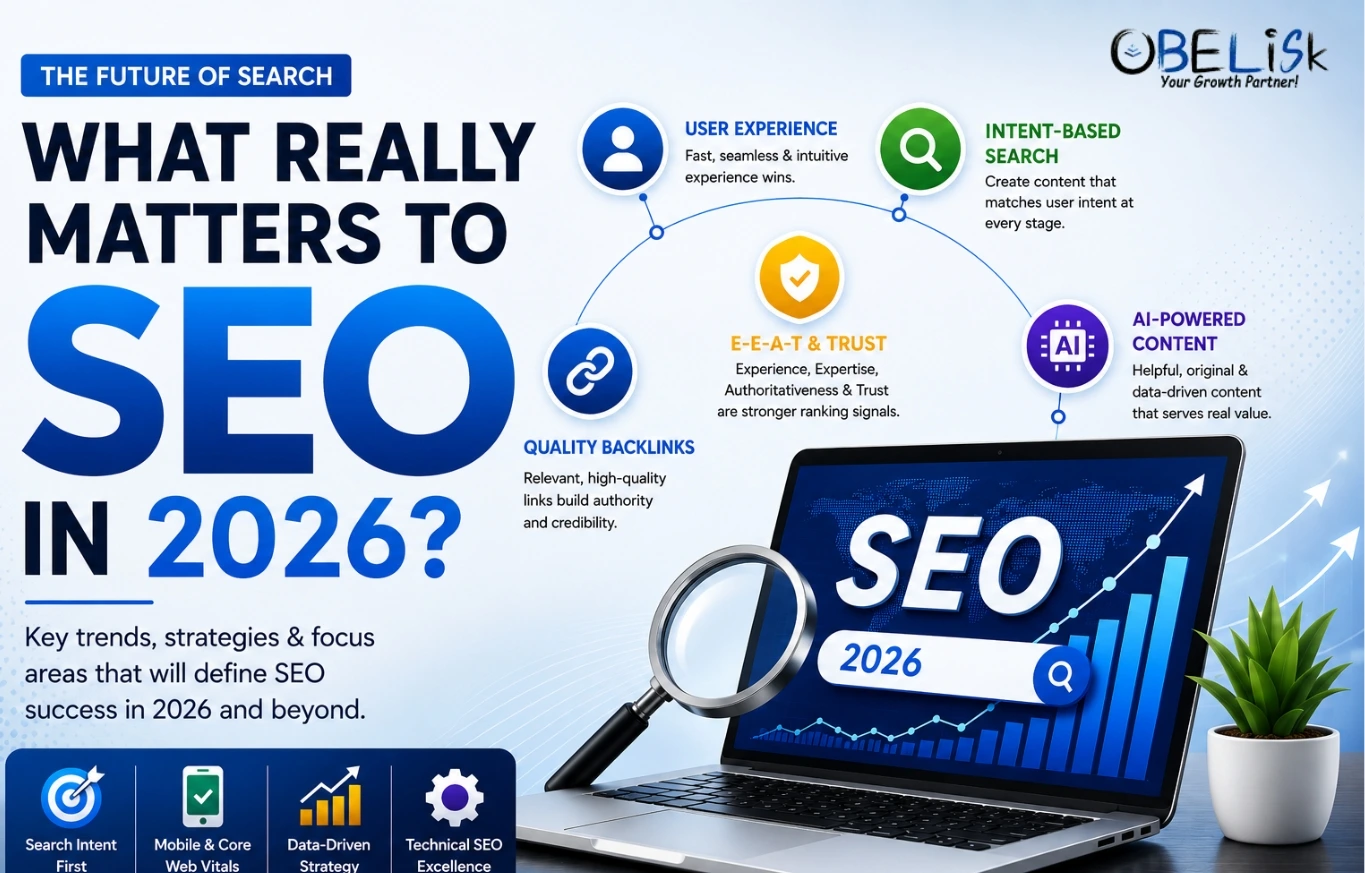
SEO has gone through a massive shift. Keyword stuffing and spammy backlinks that once worked in 2016 are now penalties waiting to happen. In 2026, Google uses AI-powered ranking systems, rewards genuine expertise, and punishes thin content harder than ever. This guide breaks down exactly what SEO factors actually move the needle today, what to stop wasting time on, and how partnering with the best SEO company in India can help you build sustainable organic growth for your business.
1. Google AI Overviews and Generative Engine Optimization (GEO)
The single biggest shift in SEO for 2026 is not a new algorithm update. It is the arrival of AI-generated answers sitting above every search result. Google AI Overviews, formerly known as SGE (Search Generative Experience), now appear for a huge percentage of informational and commercial queries. This changes the game completely.
Traditional SEO got you a blue link on page one. In 2026, the real prize is getting cited inside the AI Overview box itself. This new discipline is called Generative Engine Optimization (GEO). Businesses that leverage AI SEO services are already ahead of the curve, getting mentioned before a user even sees the search results below.
What GEO actually means for your business: Google's AI sources its answers from pages it considers highly authoritative, well-structured, and genuinely helpful. If your content is vague, generic, or does not directly answer what people ask, the AI will skip your page entirely, even if you rank on page one.
How to Optimize for AI Overviews
Google's AI pulls concise, factual summaries. Lead with the answer, then expand with supporting detail. Think of it like an inverted pyramid structure for every key section.
H2 and H3 headings that mirror real search queries help Google's AI understand what each section answers. Keyword-rich headings written in a natural, question-style format perform best.
FAQ schema, HowTo schema, and Article schema give Google's crawlers clean, machine-readable context. Pages with proper schema are significantly more likely to be cited in AI Overviews.
Google's AI references brands it trusts. Get your brand mentioned on authoritative third-party sites, maintain consistent NAP information across the web, and ensure your Wikipedia or Wikidata presence is accurate if applicable.
2. E-E-A-T: The Non-Negotiable Foundation
Google's Search Quality Rater Guidelines place E-E-A-T (Experience, Expertise, Authoritativeness, Trustworthiness) at the center of how human quality raters evaluate pages. While E-E-A-T is not a direct ranking signal in the traditional sense, it shapes the machine learning models that determine which content Google trusts enough to rank.
Experience
First-hand experience with the topic. Include original data, case studies, real examples, and personal insights that only someone who has done the work would know.
Expertise
Demonstrated knowledge of your subject matter. Author bios, credentials, citations from recognized sources, and content depth all contribute to perceived expertise.
Authoritativeness
Your reputation within your industry. Backlinks from credible sources, mentions in reputable publications, and a strong overall domain authority all signal authoritativeness to Google.
Trustworthiness
Site security (HTTPS), transparent contact information, a clear privacy policy, positive reviews, and accurate content all build the trust signals Google values most in 2026.
YMYL (Your Money or Your Life) pages covering health, finance, legal, and safety topics are held to the highest E-E-A-T standards. If your business falls into these categories, every page needs verifiable author credentials, sourced claims, and recent content reviews.
Not Sure Where Your Site Stands on E-E-A-T?
Our AI-powered SEO audit checks your content quality, authority signals, and trust factors, then gives you a clear action plan to fix the gaps fast.
3. Backlinks Still Matter, But Quality Has a New Definition
Despite years of conflicting reports, backlinks remain the most important external ranking signal Google uses. This is confirmed repeatedly by large-scale studies and by Google's own documentation. The critical shift in 2026 is that Google's AI systems have become significantly better at evaluating link quality, making low-quality links not just useless but actively harmful.
Getting 500 backlinks from the same low-authority domain counts for almost nothing. Getting five backlinks from genuine, topic-relevant, authoritative publications can move rankings substantially. This is the quality-over-quantity principle that has been true for years but has intensified dramatically.
The links that actually move rankings in 2026: Editorial mentions from authoritative publications in your niche, contextual links placed within relevant article content, links from pages with genuine organic traffic, and citations from .edu or .gov domains where relevant. Digital PR is now the most effective strategy, and our dedicated link building services are built around earning exactly these kinds of high-value placements.
Modern Link Building Strategies That Work
4. Core Web Vitals and Page Experience Signals
Google officially made Core Web Vitals a confirmed ranking signal, and in 2026 the thresholds have become stricter as the web overall gets faster. A slow-loading, visually unstable page sends negative signals to Google's ranking systems, regardless of how good the content is.
| Core Web Vital | What It Measures | Good Score | Needs Work | Impact |
|---|---|---|---|---|
| LCP (Largest Contentful Paint) | How fast the main content loads | Under 2.5 seconds | Over 4 seconds | High |
| INP (Interaction to Next Paint) | Page responsiveness to user actions | Under 200ms | Over 500ms | High |
| CLS (Cumulative Layout Shift) | Visual stability while loading | Under 0.10 | Over 0.25 | Medium |
| TTFB (Time to First Byte) | Server response speed | Under 800ms | Over 1800ms | Medium |
| Mobile Usability | Tap targets, font sizes, layout | No issues | Any viewport errors | Critical |
The fastest wins for Core Web Vitals improvement are: switching to a faster hosting provider, converting images to WebP format, implementing lazy loading, and removing render-blocking JavaScript. These four fixes alone can improve LCP scores by 40 to 60 percent on most WordPress sites.
5. Content Strategy: Depth, Intent, and Topical Authority
Publishing more content is not the same as publishing better content. In 2026, Google rewards websites that demonstrate genuine topical authority across a subject rather than sites that scatter thin content across many loosely related topics. The content pillar and cluster model has proven to be the most effective long-term content architecture, whether you are running a local campaign or scaling through international SEO services across multiple markets.
Before writing any page, determine whether the searcher's intent is informational, navigational, commercial, or transactional. A page written for the wrong intent will never rank consistently, regardless of keyword optimization.
Studies consistently show that content between 2,000 and 4,000 words earns significantly more backlinks and higher average rankings than thin content. This is not about word count padding. It is about answering follow-up questions the reader would naturally have.
Google favors freshness signals for time-sensitive topics. Updating existing high-performing content is often more effective than publishing new articles from scratch, especially for competitive keywords.
Content that includes original statistics, survey results, or data-driven analysis earns far more backlinks and citations than content that just rephrases what other sites have already published. Be the primary source, not a secondary one.
Need an SEO Content Strategy That Actually Ranks?
Obelisk Infotech builds data-driven content strategies for businesses that want real organic growth, not just more published posts.
6. Technical SEO: The Invisible Foundation
Technical SEO is the infrastructure that everything else sits on. Even the best content will fail to rank if Google cannot crawl, index, and understand it properly. In 2026, the most impactful technical SEO priorities have shifted somewhat from previous years.
Crawl Budget Optimization
Large sites with thousands of pages need to prioritize which URLs Google crawls. Blocking low-value pages with robots.txt and fixing crawl traps protects your crawl budget for important pages.
Index Coverage and Canonicalization
Duplicate content issues, incorrect canonical tags, and pagination errors are among the most damaging technical problems. Google Search Console's Index Coverage report reveals exactly which pages are excluded and why.
Internal Linking Architecture
A well-planned internal linking structure distributes PageRank effectively, helps Google understand site hierarchy, and keeps users navigating deeper into your content.
Mobile-First Indexing
Google indexes the mobile version of your site first. If your mobile experience is broken, slow, or missing content that appears on desktop, your rankings will suffer regardless of desktop performance.
7. Local SEO and Proximity Signals
For businesses serving a geographic area, local SEO is not optional. It is the primary revenue driver. In 2026, the Google Map Pack continues to dominate search results for location-based queries, appearing above organic results and generating the majority of clicks for local intent searches.
The core pillars of Local SEO in 2026: A fully optimized and actively managed Google Business Profile, consistent NAP (Name, Address, Phone Number) citations across all major directories, genuine customer reviews with regular responses, localized content on service area pages, and proximity signals through local backlinks and community mentions.
8. User Engagement Signals and Bounce Rate
Research consistently shows a strong correlation between engagement metrics and search rankings. Pages with lower bounce rates and higher average session durations tend to rank higher in Google. When users land on a page and immediately leave, it signals to Google that the page did not satisfy the search query. Over time, this behavior can lead to rankings dropping, especially for competitive keywords.
Practical Ways to Reduce Bounce Rate
Is Your Website Losing Rankings to Competitors?
Obelisk Infotech's AI-driven SEO services combine technical audits, content optimization, and authority building to deliver consistent, long-term organic growth for your business.
9. What to Stop Doing in 2026
Equally important as knowing what to do is knowing what to stop spending time and budget on. Several tactics that once delivered results now either do nothing or actively hurt your rankings.
10. 2026 SEO Quick Checklist
Use this checklist to audit your current SEO strategy and identify the highest-priority areas to address first. If you need a structured plan to work through these items, our SEO packages cover every layer from technical fixes to authority building.
| SEO Area | Action Item | Priority |
|---|---|---|
| Technical | Confirm all important pages are indexed in Google Search Console | Critical |
| Technical | Pass Core Web Vitals for LCP, INP, and CLS on mobile | Critical |
| Technical | Fix all broken internal links and 404 errors | High |
| Content | Every page has a clear, keyword-aligned title tag and meta description | Critical |
| Content | Content addresses search intent fully and answers follow-up questions | High |
| Content | Top-performing pages reviewed and updated within the past 12 months | High |
| Authority | At least one active link building outreach strategy is running | High |
| E-E-A-T | All blog posts have author bios with credentials and linked profiles | Medium |
| Local SEO | Google Business Profile is complete with photos, services, and weekly posts | Critical |
| GEO | Key pages include direct, concise answers formatted for AI Overview citation | High |
| Schema | FAQ, Article, and LocalBusiness schema implemented where appropriate | Medium |
| Analytics | GA4 and Search Console are connected and actively monitored monthly | Critical |
Frequently Asked Questions
There is no single factor. SEO in 2026 is a combination of technical health, content quality, E-E-A-T signals, and authoritative backlinks working together. That said, fixing critical technical issues comes first because great content cannot rank if Google cannot properly crawl and index it.
Yes, backlinks remain the strongest external ranking signal. The key difference in 2026 is that quality matters far more than quantity. A handful of links from genuinely authoritative, topically relevant websites is worth more than hundreds of links from low-quality sources. Digital PR and earning editorial coverage is the most effective link acquisition strategy available today.
AI Overviews have reduced click-through rates for purely informational queries where the answer is provided directly in the box. However, commercial and transactional queries still drive significant click traffic. The best response is to optimize content for AI citation while focusing your primary traffic strategy on commercial intent keywords where users still need to click through.
For a new website, expect three to six months before meaningful rankings begin to appear for low-competition keywords. Competitive keywords in established niches typically require six to twelve months of consistent work. Technical fixes and on-page optimization often show faster results, sometimes within four to six weeks, while authority building through links takes longer to reflect in rankings.
AI-generated content is not inherently bad for SEO. Google's guidance focuses on the quality and helpfulness of content rather than how it was created. The problem is mass-produced AI content that provides no original value, insight, or expertise. AI used as a writing assistant to help experienced humans produce better, faster content is perfectly acceptable and widely used by top-ranking sites.
Start by auditing your entire content library and identifying thin, low-value, or purely SEO-driven pages. Either substantially improve these pages with original expertise and genuine user value, or consolidate and redirect them to better existing content. Recovery typically takes several months and requires sitewide quality improvements rather than page-level fixes alone.
Get an SEO Strategy Built for How Search Works Today
Obelisk Infotech has helped 1,500+ businesses worldwide achieve real, measurable organic growth through data-driven SEO, AI-powered content strategies, and ethical link building. Get your free SEO audit and a clear roadmap to improve your rankings.