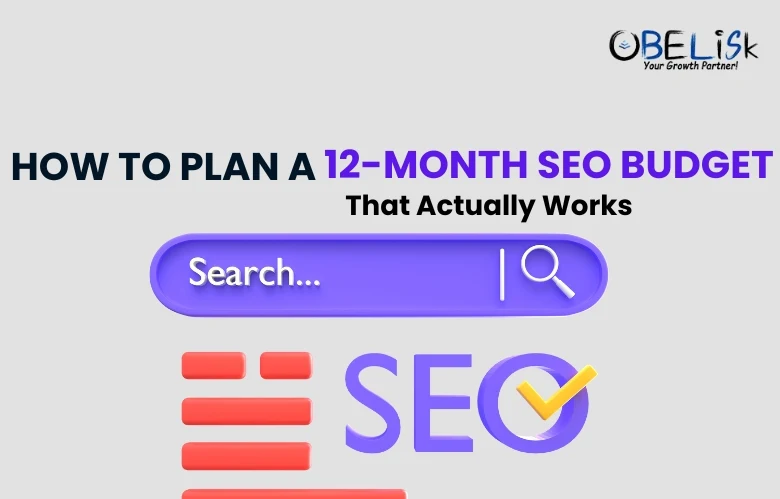
Creating a 12-month SEO budget can be a daunting task, particularly when it comes to the different prices charged by different agencies, each promising different results. However, the reality is that an SEO budget that is planned well isn’t merely a matter of numbers; it is more about strategy, consistency, and return on investment. In this guide, Obelisk Infotech explains how to plan a 12 month SEO Budget That Actually Works.
Key SEO & Organic Growth Statistics for 2025
In 2025, the search landscape is expected to be significantly influenced by these fundamental SEO and organic growth statistics.
SEO Insight | 2025 Finding |
Most pages get no organic traffic | 96–97% of pages receive zero visits |
Organic search drives most traffic | 53% of total website traffic |
Content delivers higher ROI | 3× more leads than traditional marketing |
Consistent publishing wins | 16+ blogs/month → 3.5× more traffic |
Speed impacts user behavior | 53% leave if the page loads in 3+ seconds |
Mobile leads search | 63% of all Google searches |
Backlinks fuel rankings | Top pages have 3.8× more backlinks |
Local search surges | “Near me” searches up 500%+ |
Competition rising | 2,000+ new websites created per minute |
Why These Numbers Matter for Your SEO Budget?
These stats show a clear pattern:
- Competition is increasing rapidly; your rival is not only the one but also the huge amount of new pages that come up every month.
- Consistency beats bursts as companies that put out their content regularly are the ones who get the good returns.
- Technical health is a must because the condition of your site in terms of speed, phone-compatibility, and crawlability will determine your ranking position.
- Content + backlinks yield the highest ROI, a must that is allotted the right share of the budget.
- Local + global intention is changing fast; therefore, you need to optimize constantly.
If you plan a 12-month SEO budget that overlooks these truths, you will give yourself a “set-and-forget” cost instead of a growth engine.
How to Plan a 12-Month SEO Budget That Actually Works | Obelisk Infotech
Regardless of where you stand in the market—be it a startup, an eCommerce store, or a global enterprise—this 12-month framework will match the alignment of your SEO investment to the visible business growth by measurement.
The Importance of SEO Budgeting in 2026
SEO has been and still is one of the highest-ROI marketing channels. HubSpot (2025) reports that 61% of marketers state improving SEO and increasing organic presence to the top of the list of inbound marketing priority.
Nevertheless, quite a few companies do not consider improving their website visibility through SEO as a long-term investment but rather a short-term expense. And the mistakes of budgeting follow through from there.
Adopting a one-year SEO routine will allow you to:
- Distribute your budget correctly to attain growth, and not just growth that is temporary.
- Prevent spending too much money on non-impactful months.
- Achieve a balanced approach across content, link building, and technical optimization.
- Measure ROI every three months to change strategies wisely.
At Obelisk Infotech, we have observed that clients who plan SEO investments annually experience 3X more organic growth than those who invest teak sporadically.
1. Set Transparent Business Objectives Before Budgeting
Prior to deciding how much to invest, you should have a clear understanding of your business objectives.
Consider the following questions:
- Would you like to see an increase in organic leads or in brand recognition?
- Are you focusing on local markets or aiming for worldwide reach?
- How cutthroat is your industry?
The responses will determine your SEO strategy, and consequently your budget.
For instance, a plumbing company that serves a local area may do less link-building than an international SaaS company, depending on their areas of competition and the high-competition keywords they are using.
How Goals Influence SEO Budget Needs
Objective Type | Typical Budget Weight | Impact Area |
Lead generation | 40–50% | Content + Conversion pages |
Brand visibility | 25–35% | Blogs + Top-funnel keywords |
Local dominance | 20–30% | Local citations + Reviews |
National/Global expansion | 60–80% | Content + Links + PR |
Pro Tip: Always ensure that your SEO budget is linked to tangible KPIs – traffic, rankings, leads, and conversions, rather than to vanity metrics.
2. Understand What Influences SEO Costs
A seo budget is determined by a few factors, and the seo agency is just one of them. Let’s discuss further.
Site Size and Technical Condition
The main resources of the business site with 10 pages, will be less than those of the E-commerce site with the 2000 pages. If your site’s technical aspects are not good, be prepared to spend around 10-15% of your total budget on technical SEO repairs.
Keyword Competition
The impact of ranking for “best shoes” will be more than that of ranking for “affordable leather sneakers in Delhi.” Essentially, investing in content, backlinks, and SEO tools will be dictated by the level of competition.
Target Area
Local SEO campaigns are less expensive than international or multi-location campaigns. For example, the optimization of “dentist in Chicago” is easier than that of “cosmetic dentistry USA.”
Content and Link Building
There is no negotiation on high-quality content and credible backlinks. Ahrefs (2025) reports that 91% of web pages are never visited by anyone, usually due to poor content and invisibility (the latter owes much to lack of backlinks).
These elements will take up 40-50% of your SEO budget, but they will also be the ones to deliver the best ROI.
Cost Driver | Budget Share | Reason |
Technical SEO | 10–15% | Fix speed, indexing, and site errors |
Keyword competition | 20–25% | Depends on niche difficulty |
Geographic scope | 15–20% | Local vs. national/ global |
Content + Backlinks | 40–50% | Highest ROI components |
3. Dispense Your SEO Budget every month
Rather than one large amount, split your SEO budget into smaller monthly segments that are easier to manage. This is an example of how Obelisk Infotech’s 12-month SEO plan is structured:
| Month | Focus Area | Budget % |
| 1–2 | Technical SEO audit, website optimization | 20% |
| 3–5 | Content strategy and keyword expansion | 25% |
| 6–8 | Link building, PR outreach, and guest posting | 25% |
| 9–10 | Conversion optimization, schema markup | 15% |
| 11–12 | Performance analysis, retargeting, fine-tuning | 15% |
4. Allocate Budget for SEO Tools and Analytics
You should not disregard the cost of tools; they are the very foundation of data-driven SEO.
Absolutely necessary tools, like Ahrefs, SEMrush, Screaming Frog, and Google Analytics 4, are the main ones used to do keyword research, monitor backlinks, and analyze competitors.
Plan for a budget allocation of 5 to 10 percent of the total SEO budget for tools and automation.
Tool | Monthly Cost | Purpose |
Ahrefs | $129–$249 | Backlinks + Competitors |
SEMrush | $129–$249 | Keywords + Analytics |
Screaming Frog | $19 (annual license) | Technical crawling |
GA4 | Free | Traffic insights |
Our company, Obelisk Infotech, uses AI to analyze SEO data and tell us about ranking opportunities and ROI trends, which is a big advantage for our clients over the competition.
5. Invest in Content, This is Your Long-Term Asset
Content creation is where your SEO budget gives you the best return.
You will require:
- Long-tail and LSI keyword-optimized blog posts.
- Transactional intent-targeted service and landing pages.
- Informational guides and how-to content.
- Visuals, infographics, and videos.
Content Type | Typical ROI | Time to Impact |
Blogs | 3–5× | 3–6 months |
Landing pages | High | Immediate–90 days |
Guides | Medium | 4–8 months |
Videos | Medium–High | 2–5 months |
According to Statista (2025), businesses that consistently publish and optimize their content attract 67% more leads than those that do not.
Content calendar planning and monthly funds allocation for both new and updated content are essential since SEO is a process of evolution rather than a one-time installation.
6. Scalability and Contingencies Planning
There will be a gradual increase in your SEO results. However, when the ranking goes up, you may need to increase the amount of content, switch to targeting new keywords, or do more link building.
That is the reason a 10% contingency fund for scaling should be set aside in every 12-month SEO plan.
This buffer allows you to respond urgently to the following situations:
- Changes in Google’s algorithms
- Competitor’s campaigns
- Emerging keyword opportunities.
Trigger Event | Typical Additional Spend Needed |
Google algorithm update | 10–20% |
Competitor link surge | 15–25% |
New product/service launch | 20–40% |
7. Measure, Review, and Adjust Quarterly
No SEO budget should remain unchanged. Performance should be measured with metrics like:
- Organic traffic growth
- Keyword position changes
- Conversions and lead quality
- ROI per content asset
- Use this data to redirect resources to where they have the greatest effect.
At Obelisk Infotech, we offer transparent monthly reports demonstrating keyword growth, content performance, and revenue contribution, so clients are fully informed about their investment.
8. Common Budget Mistakes to Avoid
Underestimating long-term ROI: SEO requires a lot of time; do not expect to get rankings overnight.
- Neglecting content updates: Old content can bring down authority.
- Going through technical fixes: A fast, well-optimized website supports all efforts.
- Taking risks with backlinks: Cheap links can ruin domain trust.
- Keep in mind, SEO is not a burden; it’s a compound investment in your brand’s future.
- How Obelisk Infotech Helps Businesses Plan Smarter SEO Budgets.
At Obelisk Infotech, we design personalized 12-month SEO roadmaps that align with your business objectives and budget.
Our methodology has:
- Comprehensive SEO audits and competitive benchmarking
- AI-based keyword research and opportunity mapping
- Monthly growth tracking and ROI reporting
- Transparent cost breakdowns, no hidden fees.
Our team has over a decade of experience in SEO and digital marketing, and we have helped clients worldwide increase visibility, leads, and revenue through well-planned SEO investments.
If you’re looking to create a data-driven SEO budget that yields consistent results throughout the year, choose to work with the experts who will make every dollar count.
9. How Much Businesses Actually Spend on SEO in 2025
It is good to know before you make a budget for 12 months that similar businesses are spending on SEO. The global data for 2025 shows a distinct pattern: firms treating SEO as a long-term engine invest continuously month after month.
SEO Spending Benchmarks (2025)
Business Type | Avg Monthly SEO Spend (2025) |
Small businesses | $1,500–$3,000 |
Mid-size companies | $5,000–$15,000 |
Enterprise companies | $25,000+ |
10. The Cost of Doing Nothing: What Happens If You Underfund SEO
Not investing enough in SEO translates into financial losses.
2025 Data Highlights:
- 96-97% of the pages never receive any organic traffic at all.
- Companies that ignore SEO pay 2-3x more for ads.
Impact of Underfunding SEO
Underfunded Scenario | Expected Loss |
Slow site (3+ seconds load) | 53% traffic drop |
No content creation | 67% fewer leads |
No link building | 3.8× lower ranking potential |
Not investing in SEO is more costly than investing in it.
11. Seasonal SEO Budget Planning Based on Industry Trends
Every industry has its busiest periods. By switching your SEO budget, you are sure to win when the demand is at its highest.
2025 Seasonal Trends
Industry | Peak SEO Season |
E-commerce | Oct–Dec |
Travel & Hospitality | Mar–June |
Education | May–Aug |
Seasonal budgeting gets rid of the chances of losing out on sales during the months when the customers are most willing to buy.
12. Budget for Video SEO & YouTube Search (A 2025 Essential)
YouTube can be regarded as the second homepage of Google. Some companies end up getting their customers’ attention through video SEO.
2025 Video SEO Data:
- YouTube influences 26% of the total Google search views.
- The use of video content in the sales process can lead to a 70-80% increase in conversions.
Estimated Video SEO Costs
Task | Estimated Cost (2025) |
Script + Production | $150–$500/video |
Video Editing | $100–$300/video |
Optimization + Thumbnails | $40–$100/video |
Conclusion
In conclusion, the importance of a well-organized 12-month SEO budget cannot be overstated as it is the one thing that will take your company through the roof in terms of growth and investments. Besides, by setting measurable goals, having a solid understanding of the cost factors, and making a wise budget allocation, you will be able to pull up the results that matter.