It’s 2026 already, and the battle among the search players has reached its peak in the locality category. For companies that have their presence in several cities or regions, the success in local SEO for multi-location businesses is no longer a matter of choice but a basic requirement.
Your local visibility affects traffic, calls, and conversions directly, no matter if you manage a group of restaurants, retail outlets, health centers, or service outlets. The digital landscape has transformed, as well as local SEO has become more centered on AI-based search, understanding user intent, and hyperlocal personalization.
Obelisk Infotech presents an all-inclusive guide for multi-location businesses on how to be the top local search result in 2026 and the future.
Surge in Local Search Demand: What the 2025 Data Shows
From 2024-2025, local search is one of the most important and vibrant marketing channels, thus making it a top choice to invest in this area of marketing. By 2025, around 50% of Google’s searches are estimated to carry local intent.
Key 2025 Statistics on Local Search:
Metric | Value / Range |
Searches with local intent | ~ 46% |
Growth in “near me” searches | ~ 57% |
Mobile local queries leading to action | ~ 76% |
Visibility boost for multi-location brands | 3× higher impressions |
Why Multi-Location Brands Cannot Ignore 2025 Reputation Data?
In 2025, high local rankings and consumer choices are ensured by customer reviews. Brands with multiple locations cannot risk having one location with low reviews or a different one with high ratings, as more than 90% of consumers will check reviews of a store before visiting.
Review Factor | Impact on Local SEO |
Rating below 4.0★ | 28–35% drop in clicks |
40–50+ recent reviews | 2× more Local Pack visibility |
High variation across branches | 25% drop in user trust |
Responding to reviews | 10–14% boost in engagement |
Local SEO Guide for Multi-Location Businesses in 2026
Multi-location SEO is the technique of making your digital presence more appealing to local customers and thus getting each of your business locations to feature in Google’s local search results, Google Maps, and “near me” searches.
Instead of following the traditional SEO approach, which concentrates on one site or one area, multi-location SEO works by building local relevance at scale, making sure that every branch or outlet is visible to the customers who are closest to them.
Suppose you have stores in New York, Chicago, and Los Angeles, then each place should be visible to the users when they search for:
- “Best Store Nearby”
- “Top-rated [service] in Chicago”
- “Local [business type] in Los Angeles”
That is the advantage of using tactical local SEO for multi-location brands.
Key Local SEO Ranking Factors in 2026
The evolution of the Google algorithms has resulted in the delivery of local search results that are more personalized, intent-based, and AI-optimized. Let us discuss what matters most in 2026:
The optimization of the Google Business Profile (GBP)
Your GBP is like your online shop window. There is a higher chance of users seeing complete profiles with accurate NAP (Name, Address, Phone), images, products, and service updates.
The user’s proximity and intent
The AI-based proximity algorithms from Google are used to spot business locations that are closest to the user. Ensure that you select hyperlocal business categories and relevant keywords.
Local Citations
Credibility is increased by having consistent listings all over the different directories (Yelp, Justdial, Foursquare, Bing Places).
Reviews & Reputation Management
Genuine and frequent reviews greatly increase trust signals. Besides, responding to both positive and negative reviews boosts ranking and engagement.
Localized Content Marketing
Content should be rich in city names, regional keywords, and local trends.
Backlinks from Local Sources
Building partnerships with regional blogs, news outlets, or chambers of commerce increases local authority.
Mobile Optimization & Page Speed
The majority of local searches (65% or more) come from mobile; therefore, speed and UX are critical to ranking.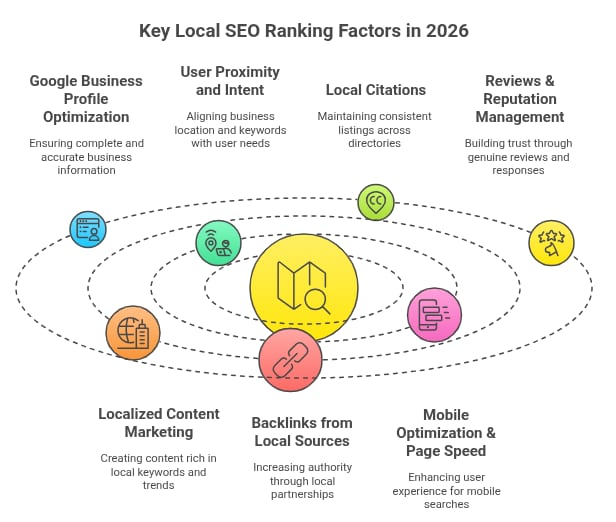
Best Local SEO Strategies for Multi-Location Businesses in 2026
1. Create Dedicated Location Pages
Every single business site benefits from having a dedicated and optimized landing page.
Incorporate:
- The title tag and meta description are unique to the city
- Keywords related to the area
- Google Map integration
- Reviews and testimonials related to the specific location
- Schema markup (LocalBusiness)
Tip: Make sure URLs are clear and structured, for instance,
yourdomain.com/locations/chicago/
2. Optimize Google Business Profiles (GBP) for Every Location
Each location must have a GBP listing that is verified on its own.
- Add high-quality photos of high quality
- Include categories for services and products
- Post updates every week
- Invite customers to write reviews
- Include localized keywords in business descriptions.
Multi-Location GBP Performance Benchmarks for 2025
GBP Optimization Element | Improvement % (2026) |
High-quality photos | +50–60% engagement |
Weekly posts | +28–32% user actions |
Detailed services/products | +18–22% conversions |
Fast review responses | +20–26% interactions |
Scaling GBP optimization across all branches can increase a multi-location brand’s combined visibility in Maps and Local Packs by up to 300–500%.
At Obelisk Infotech, we help businesses with multiple locations to manage their GBP listings at scale; thus, every location is guaranteed to be seen in the Google Map Pack.
3. Maintain Consistency Across All Citations
Always use the same NAP (Name, Address, Phone) details in all directories. Even the smallest differences can lead to search engines getting confused.
4. Make the Most of AI-Powered Local Keywords Research
In 2026, the understanding of search intent is going to be the deciding factor, while keywords will just be secondary.
Hire AI-powered Services for SEO (like keyword clusters of Semrush or ChatGPT) to show you the local queries that will suit voice search the most.
Some illustrations:
- “Best [service] vid near me”
- “Affordable [product] in [town]”
- “Where to buy [brand] in [area]”
5. Make Use of Local Reviews & User-Generated Content
Positive reviews can be considered as the new “local backlinks.”
Ask your happy customers to write about their experience using city-specific keywords (e.g., “Best spa in Dallas”).
Show review snippets on local pages to get better conversion and be viewed as more authentic.
6. Local Link Building Should Be a Priority
Conduct outreach to:
- Area blogs or influencers
- Local business groups
- Community events and sponsorships.
These links enhance domain authority and convey Google’s local trust signs.
7. Optimize for Voice Search
According to Google Research, by the year 2026, more than half of the local searches will be done through voice commands (Google Research, 2025).
Target natural language queries like:
“Hey Google, find me a digital marketing agency within my vicinity.”
Develop content in the form of FAQs and employ natural language, phrases, and long-tail keywords.
8. Monitor the SEO Performance of Multiple Locations
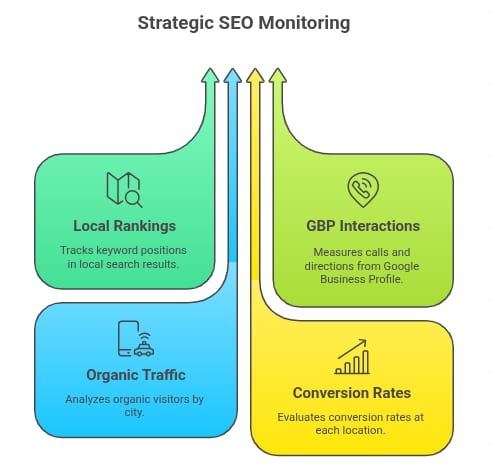
Analytics tools should be used to monitor the performance on both global and local levels.
The metrics to follow up on are:
- Local rankings of the targeted keywords
- Calls and directions generated from GBP
- Number of organic visitors per city
- Conversion rate at each location.
Obelisk Infotech gives you sophisticated reporting dashboards that monitor the performance of location-based SEO, making sure that every outlet has measurable ROI.
9. Local Landing Page Performance
For multi-location businesses, by the year 2025, the need for location-specific landing pages has grown tremendously, as they are the ones that bring in more traffic and sales compared to the generic store locator pages. Their capacity to provide locally relevant content, speedy load times, and alignment with strong searches for intent makes them one of the most high-performing assets in local SEO.
Here‘s the performance Impact of Local Landing Pages:
Performance Metric | Improvement After Optimization |
Organic traffic | +130–160% |
Calls & direction requests | +30–40% |
Local Pack visibility | +45–70% |
Conversion rate | +18–25% |
10. Usage of Mobile & Voice Search in Local SEO
In 2025, mobile and voice search are expected to become the major means for people to find local businesses, thus affecting the local SEO strategies of multi-location brands. Mobile optimization is a real competition-winning strategy for brands in view of the rising number of smartphone users and voice search users.
Key Data of Mobile & Voice Search:
Metric (2025) | Value |
Share of local searches from mobile | 65–70% |
YoY growth in voice “near me” searches | 22% |
Weekly local voice searches by users | 58% |
Visibility boost for voice-optimized brands | 17–24% |
11. AI-Driven Local Search & Personalization
Today, Google’s artificial intelligence is doing a lot by personalizing the local search results of users based on their location, behavior, and intent. In this case, structured data, hyperlocal content, and relevance signals are of great importance to brands with multiple locations.
2025 AI & Personalization Data:
AI Factor | 2025 Impact |
Personalized SERPs | ~40% variation in local results |
Schema markup | +35–40% CTR lift |
AI relevance signals | Higher local visibility for optimized pages |
Hyperlocal content | Better rankings for neighborhood pages |
12. Optimizing Local SEO ROI
In 2025, local SEO consistently outperforms paid search, social media, and traditional advertising as the most effective acquisition channel with the highest return on investment. It is a key factor in multi-location brands’ revenue due to its strong offline impact, high intent conversion, and low lead cost.
A tabulated 2025 ROI comparison:
Channel | Avg. Cost per Lead | Conversion Strength | Long-Term ROI |
Local SEO | Low | High (strong intent) | Highest |
Paid Search | Medium–High | Medium | Medium |
Social Ads | High | Low–Medium | Low |
Traditional Ads | Very High | Low | Lowest |
Multi-location brands that keep up with local SEO consistently see ROI hikes over the years, as it is compounding and evergreen.
Multi-Location SEO vs Traditional SEO: 2025 Comparative Data
Both traditional SEO and multi-location SEO aim for increasing visibility, but their methods differ greatly. The performance gap has increased in 2025 due to the growth of local-intent searches and Google Maps’ dominance. Multi-location SEO focuses on hyper-local relevance and real-world conversions, while traditional SEO focuses on national reach, authority, and long-term organic growth.
2025 Comparative Data:
Feature | Multi-Location SEO | Traditional SEO |
Audience | Geo-specific users; city/area-based | Nationwide/global users |
Goal | Foot traffic, calls, local conversions | Organic traffic, authority, and online conversions |
Ranking Drivers | Proximity, GBP, NAP, reviews, citations | DA, content depth, backlinks, UX |
Keywords | Geo terms (“plumber Austin”) | Broad/non-geo (“project management tools”) |
Platforms | Maps, GBP, local directories | Organic SERPs, website pages |
Conversions | High: 28% buy in 24 hrs; 14.6% close rate | Lower early conversions; 14.6% close rate long-term |
How Multi-Location Businesses Prefer Obelisk Infotech
Obelisk Infotech is the place where AI-powered Local SEO solutions for multi-location companies are provided. We enable you to:
- Effortlessly manage multiple Google Business Profiles
- Local landing pages are optimized for maximum visibility
- Building up consistent citations and authority links
- Generating location-based leads that convert.

Our customized SEO strategies focus on scalability so that your brand is everywhere across cities, states, and countries.
Because in 2026, visibility is not only about being online. It is about being found everywhere locally.
Conclusion
In conclusion, local SEO becomes the main factor for multi-location firms in 2026 to raise their profile and draw in customers. The main methods are optimizing Google Business Profiles, making separate pages for each location, and providing good citations. These actions will allow businesses to interact with the local audience effectively. Making user intent and local relevance the main focus will not only make them less visible but also more present in their communities.